
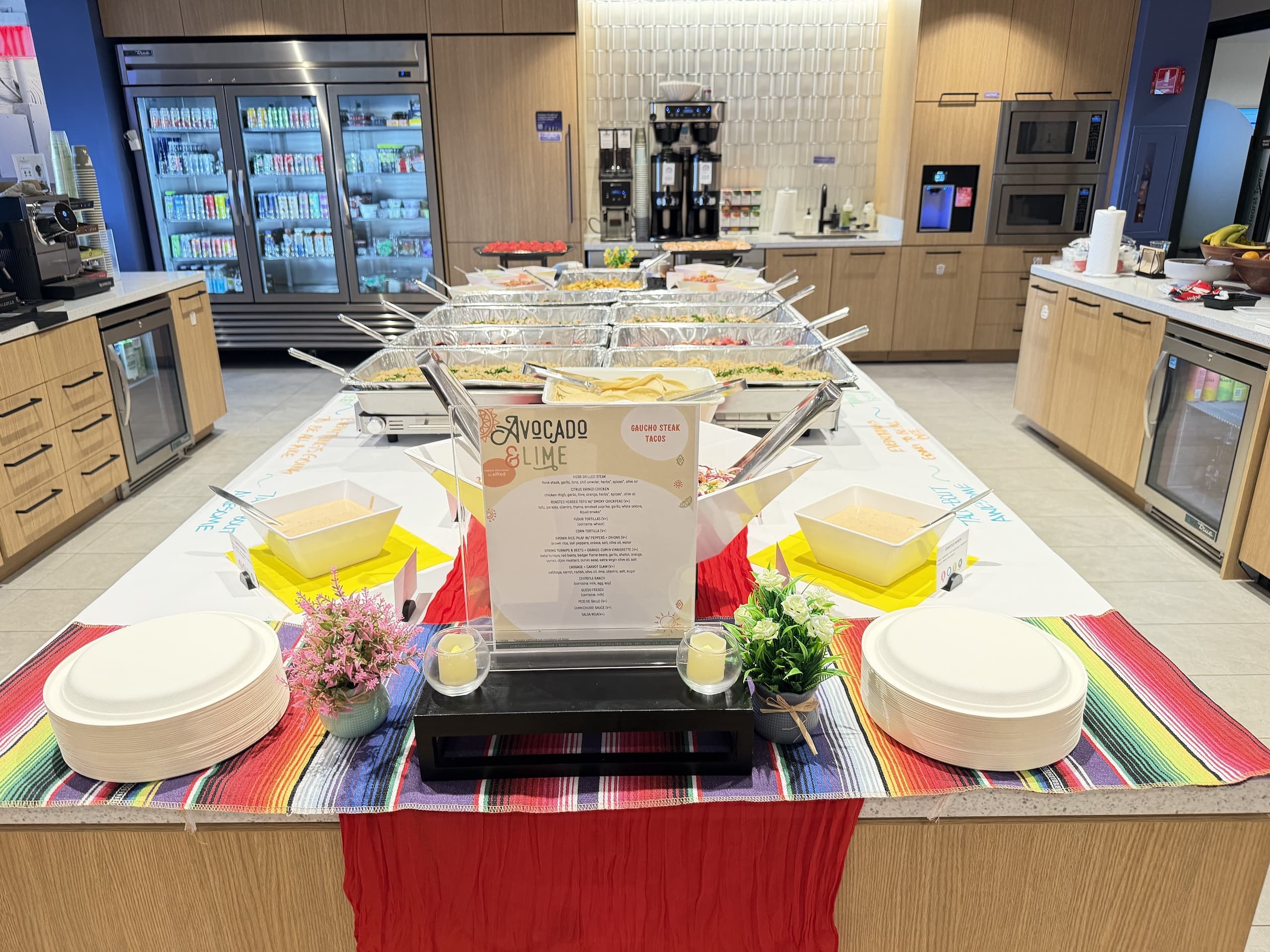
Choosing a workplace food partner involves more than comparing menus and prices. The right provider needs to deliver a consistent employee experience while managing the operational details that make a food program successful.
Whether you’re introducing office lunches, replacing an existing vendor, or managing food programs across multiple locations, this guide explains the available service models, what to look for in a provider, and how to evaluate your options.
What types of workplace food providers are available?
Most workplace food programs fall into four categories. Each offers a different level of service, flexibility, and operational support.
| Service model | How it works | Best suited for |
|---|---|---|
| Recurring corporate catering | A dedicated partner prepares and delivers meals on a recurring schedule, often with setup, service, and cleanup | Offices that want a consistent lunch program without an on-site kitchen |
| Catering marketplaces | A platform connects companies with restaurants and caterers, offering a range of ordering options | Teams prioritizing restaurant variety and flexible ordering |
| On-site kitchens and cafés | Food is prepared and served in the workplace using dedicated kitchen facilities and staff | Larger offices with kitchen infrastructure and regular employee attendance |
| Meal ordering platforms | Employees select individual meals, often through an app or ordering portal | Offices that prefer individual ordering over a shared dining experience |
Some providers specialize in one model. Others can support multiple configurations, depending on the workplace.
What should you compare when evaluating providers?
1. Food quality and menu variety
Ask where meals are prepared, who develops the menus, and how frequently offerings change.
Look for a provider that can accommodate dietary preferences and allergies, maintain quality at different headcounts, and adapt menus based on employee feedback.
2. Operational responsibility
Understand exactly what the provider manages.
Does the service include delivery, setup, food presentation, equipment, staffing, cleanup, and waste management? Or will your workplace team be responsible for coordinating some of those activities?
The total operational workload matters as much as the food itself.
3. Pricing and budget predictability
Compare the full cost of each program, not just the advertised price per meal.
Ask about delivery and service fees, staffing, equipment, minimum commitments, and how billing changes when attendance fluctuates.
A predictable pricing structure makes it easier to manage budgets and explain costs to leadership.
4. Flexibility as attendance changes
Office attendance can vary significantly throughout the week.
Ask how providers forecast participation, adjust quantities, manage last-minute changes, and minimize unused food.
A strong program should respond to actual workplace attendance rather than assume every day looks the same.
5. Reporting and employee feedback
Food programs should provide information that helps workplace teams make decisions.
Useful reporting may include meal participation, spending, dietary preferences, employee feedback, and food waste.
Ask how frequently reporting is provided and whether the provider uses that information to improve menus and service.
6. Multi-location capabilities
For companies operating across several offices, evaluate whether a provider can deliver consistent standards in every market.
Ask whether locations have dedicated local teams, how pricing and service are coordinated, and whether the provider offers centralized account management and reporting.
How do leading workplace food providers differ?
Several established providers serve different needs within the workplace food market.
| Provider | Primary approach | Worth evaluating for |
|---|---|---|
| Sifted | Fully managed recurring corporate catering and on-site workplace food programs | Companies seeking consistent food, service, and reporting, including across multiple offices |
| Fooda | Workplace food programs that include restaurant-based offerings and food service solutions | Companies interested in restaurant variety and workplace dining options |
| ZeroCater | Corporate meal programs and workplace food solutions | Companies evaluating recurring office meals and broader food program support |
| Cater2.me | Corporate catering and workplace meal programs | Teams comparing curated meal programs and catering options |
| ezCater | Online catering marketplace and business food ordering solutions | Companies needing access to a broad network of caterers and ordering options |
Provider capabilities, service areas, and minimums can change. Confirm current offerings directly with each company before making a decision.
Questions to ask before choosing a workplace food partner
- Who prepares the food, and where is it made?
- What services are included beyond meal delivery?
- How do you manage changing office attendance?
- What happens when participation is higher or lower than expected?
- How are dietary needs and allergens handled?
- What reporting will our workplace team receive?
- Can you support multiple offices with consistent service standards?
- Who is responsible for resolving day-to-day service issues?
- How do you collect employee feedback and improve the program?
- What are the minimum headcount, frequency, and contract requirements?
When is Sifted a good fit?
Sifted works with companies that want a fully managed workplace food program rather than individual or occasional catering orders.
Our local culinary teams prepare fresh meals in commercial kitchens and manage delivery, setup, service, cleanup, and food donation. We also operate on-site kitchens and cafés for workplaces with the appropriate facilities.
Sifted is particularly well suited for:
- Offices serving 50 or more employees per day
- Companies providing lunch three to five days per week
- Workplace teams that want one accountable food partner
- Businesses managing programs across multiple locations
- Organizations that value predictable pricing, employee feedback, and reporting
Sifted serves Atlanta, Austin, Chicago, Denver, New York City, Salt Lake City, San Francisco, and Seattle.
Explore our Corporate Catering and Multi-Location Workplace Food Programs.
Frequently asked questions
What is the difference between corporate catering and a workplace food program?
Corporate catering generally refers to food prepared and delivered for a business. A workplace food program is an ongoing service that may also include menu planning, staffing, setup, employee feedback, reporting, and other operational responsibilities.
Is recurring catering better than an on-site café?
It depends on the workplace. Recurring catering can be a good fit for offices without commercial kitchens. On-site cafés may be better suited to larger workplaces with kitchen infrastructure and consistent daily demand.
How much does a workplace food program cost?
Pricing depends on the city, headcount, service frequency, menu, and staffing requirements. For recurring lunch programs, companies should compare the full per-person cost, including any delivery, service, and equipment charges.
Can one provider manage food programs across multiple cities?
Yes. Some workplace food providers operate across multiple markets. Companies should confirm which cities are supported, whether local teams deliver the service, and how standards and reporting are managed across locations.
How do you measure whether a workplace food program is successful?
Common measures include employee participation, cost per meal, employee satisfaction, food waste, and the time required from internal workplace teams.
Find the right food program for your workplace
Sifted helps companies build and operate recurring workplace food programs, from chef-prepared office lunches to fully managed on-site cafés.
Related resources

Office Catering Models: Side-by-side Comparison Chart

Feeding Culture: Complete Guide to Office Catering

Lunch Money: Understanding the Funding Structures
Let's talk about
your workplace
food program.