
There are several ways to provide food at work, but most programs fall into three models: carry-in catering, an on-site café, or restaurant delivery through an aggregator.
The right model depends on your office size, available space, budget, attendance patterns, and how much of the program you want to manage internally.
Here’s how the three approaches compare.
Carry-In Catering
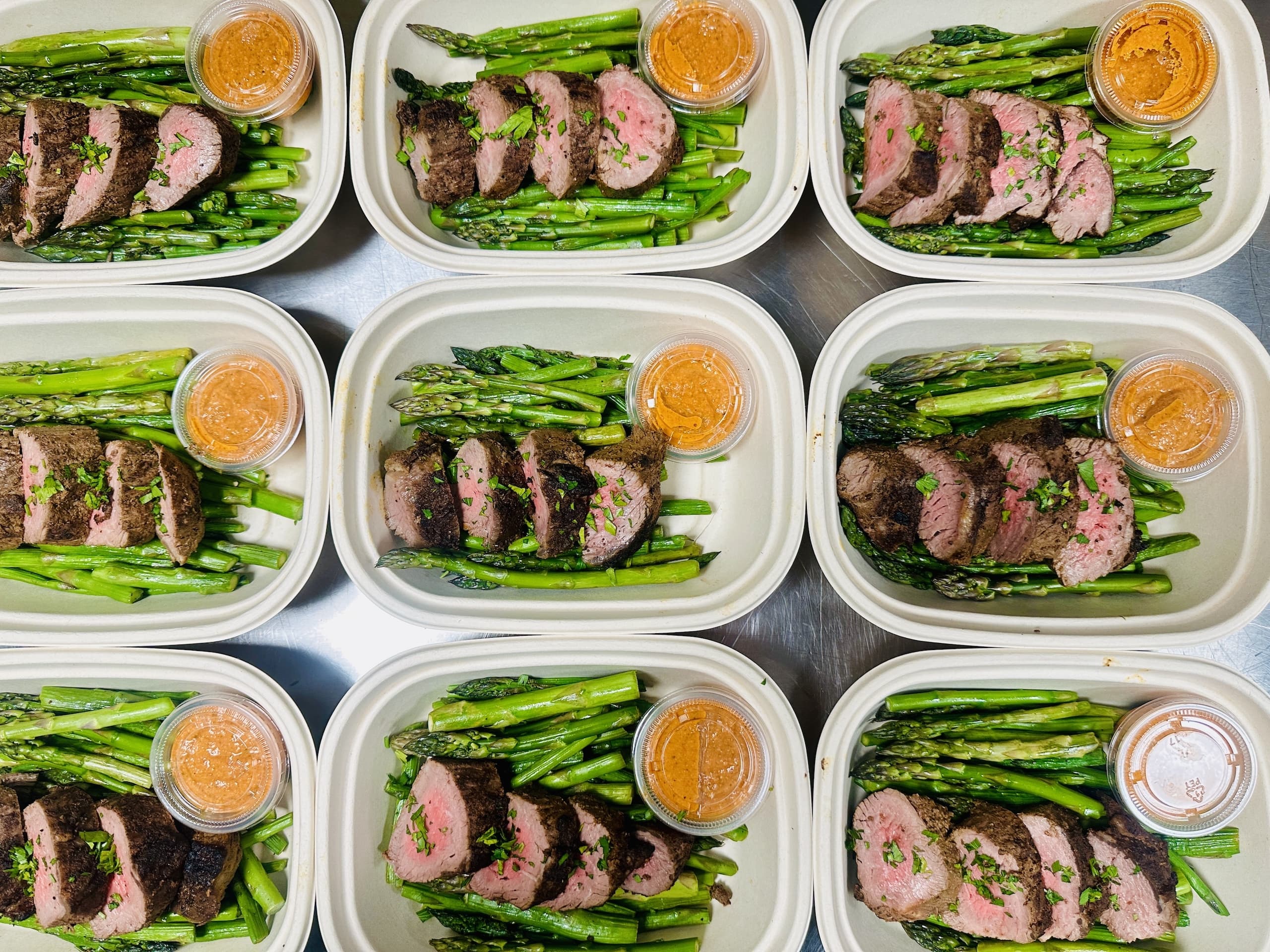
With carry-in catering, meals are prepared in a commercial kitchen and delivered to the workplace for service. Depending on the program, the catering team may also handle setup, service, cleanup, menu planning, dietary accommodations, and reporting.
Best suited for: Offices of roughly 50–500 employees, particularly workplaces that want a managed food program without building a commercial kitchen.
Advantages:
- Relatively easy to scale as attendance changes
- Minimal kitchen infrastructure required
- Wide variety of cuisines and menus
- Dietary needs and allergens can be incorporated into menu planning
- Professional setup and service can be included
- Per-person pricing makes costs relatively predictable
- Strong catering partners can provide consumption data, reporting, and analytics
- Menus and special events can be customized
Considerations:
Employees generally choose from a curated menu rather than ordering individual meals, and food must be transported from an off-site kitchen.
On-Site Café
An on-site café brings the kitchen and culinary team directly into the workplace. Food is prepared on-site by an internal or contracted culinary team.
Best suited for: Larger workplaces, typically 500+ employees, with the space and consistent attendance needed to support a permanent food operation.
Advantages:
- Food prepared on-site
- Significant control over ingredients, sourcing, labeling, and food safety
- Multiple stations and meal formats can be offered
- Highly customizable menus
- Employees can make selections at the point of service
- Strong flexibility for events and special programming
- Detailed operational and consumption reporting can be built into the program
Considerations:
An on-site café requires commercial kitchen infrastructure and carries higher fixed costs. Staffing, equipment, compliance, and day-to-day operations also require considerably more management.
Restaurant Aggregators and Food Delivery
Restaurant aggregators allow employees to order meals from participating local restaurants, usually through an app or online platform.
Best suited for: Smaller or distributed teams, workplaces with inconsistent attendance, or companies that prioritize individual meal choice.
Advantages:
- Employees can choose their own meals
- Minimal on-site infrastructure required
- Flexible as daily attendance changes
- Access to multiple local restaurants
- Useful for smaller or highly distributed offices
Considerations:
Food quality, labeling, allergen management, and consistency vary by restaurant. Service is generally limited, with employees often collecting individually packaged meals themselves.
Companies also have less direct control over food preparation and ingredient sourcing, and costs may include restaurant pricing plus delivery or platform fees.
How the Models Compare
| Criteria | Carry-In Catering | On-Site Café | Restaurant Delivery |
|---|---|---|---|
| Food preparation | Off-site commercial kitchen | On-site kitchen | Partner restaurants |
| Typical office size | 50–500 | 500+ | Smaller or distributed teams |
| On-site infrastructure | Minimal | Full commercial kitchen | Minimal |
| Client management | Low | High | Low to moderate |
| Ability to scale attendance | High | More difficult due to fixed overhead | High |
| Employee choice | Curated menu | Multiple on-site choices | Individual ordering |
| Service | Catering staff can set up and serve | Dedicated on-site staff | Often self-service |
| Menu customization | High | Very high | Limited by restaurant partners |
| Reporting & analytics | Available with advanced providers | Often highly detailed | Primarily ordering and spend data |
| Pricing | Typically per person | Higher fixed + food costs | Food + delivery/platform fees |
Which Office Catering Model Is Right for You?
The decision often comes down to scale and infrastructure.
For a large headquarters with predictable daily attendance and an existing commercial kitchen, an on-site café can provide the greatest level of control and customization.
For smaller or distributed teams where individual choice is the priority, restaurant delivery may make sense.
Carry-in catering sits between the two. It can provide many of the benefits of a managed workplace food program, including professional service, menu planning, dietary management, customization, and reporting, without the fixed infrastructure of an on-site kitchen.
For companies with changing attendance or multiple offices, that flexibility can be particularly valuable.
Related resources

Feeding Culture: Complete Guide to Office Catering

Lunch Money: Understanding the Funding Structures

Corporate Catering Pricing by City
Let's talk about
your workplace
food program.