Feeding people at scale has become an intricate act of coordination, where culture, logistics, and data converge across continents and time zones. The best programs balance local flavor with global consistency, pairing human hospitality with analytical precision.
This paper explores how Sifted and its partners design food systems that are both flexible and unified. These programs keep teams connected, no matter where they gather.
Across the world’s most innovative companies, the work of feeding people has become an extraordinary act of coordination. Global Food and Beverage leaders oversee programs that operate like living ecosystems. They span continents, time zones, and thousands of daily meals.
They’re balancing local flavor with global consistency, meeting sustainability goals while adapting to hybrid schedules, and using real-time data to guide decisions once made by intuition.
Managing food at this scale requires not only culinary excellence, but systems thinking. It requires the ability to connect culture, logistics, and analytics into a single, responsive network.
The best programs achieve a rare combination of warmth and precision. They serve food that feels local but is supported by global infrastructure; they reflect the tastes of each city while maintaining a cohesive brand identity.
Behind that success are leaders who know how to bridge the human side of hospitality with the operational and analytical demands of global enterprise.
This paper explores how those leaders and their partners manage the complexity of modern food programs. It examines what it takes to scale seamlessly across formats, from carry-in catering to full corporate cafeterias, and how data and design together can create a workplace dining experience that feels connected, consistent, and alive.
The Modern Mandate for Food and Beverage Leaders
Food and Beverage leaders today operate at the crossroads of logistics, culture, and care.
They are responsible not just for feeding teams, but for orchestrating daily rituals that shape how people gather and work. Their programs touch everything from sustainability goals to employee experience, often functioning as one of the most visible expressions of company culture.
In practice, this means building systems that adapt to office size, geography, and culture.
Leaders must manage a range of formats: carry-in catering for smaller offices, hybrid cafés for mid-size hubs, and full-scale cafeterias for global headquarters. All of this while maintaining quality and efficiency across all of them.
Why Scalability and Flexibility Matter
Global companies evolve constantly: they open new offices, restructure teams, and expand into new regions. Their food programs must be just as flexible.
Working with a vendor capable of scaling alongside the client delivers distinct advantages.
Consistency across cities reassures employees that no matter where they work, they’ll experience the same level of quality and care.
Operational continuity reduces the need to onboard multiple vendors or reinvent processes with each expansion.
And perhaps most importantly, a scalable partner can localize menus and formats to fit each workspace, ensuring the service complements the environment rather than forcing a one-size-fits-all model.
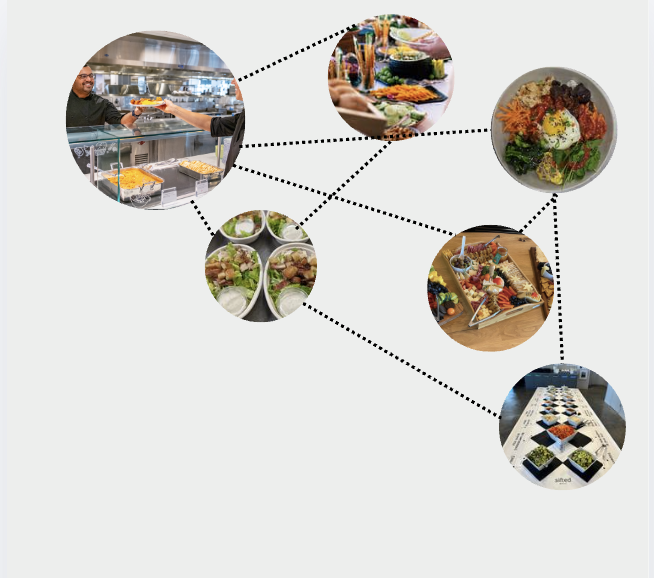
Sifted’s approach allows clients to move fluidly between formats: carry-in catering for offices under 800 employees, hybrid cafés for mid-size locations, and full-service cafeterias for headquarters and large campuses.
All are supported by a unified analytics and management infrastructure that keeps data across markets, like participation, waste, satisfaction.
Managing the Human, Operational, and Analytical Dimensions
Modern food programs succeed when they integrate three essential dimensions: the human, the operational, and the analytical.
The Human Side
Hospitality remains the foundation.
No dashboard can replace the experience of being greeted by name or discovering that a chef remembered your favorite dish.
Sifted invests heavily in training hosts and culinary teams to create genuine connections.
The Operational Side
Behind the scenes, every successful lunch is the result of careful orchestration.
Ingredient sourcing, food safety, staffing, menu rotation, and waste management must all operate flawlessly.
Sifted’s kitchens are designed to run zero-waste, with real-time donation tracking and precise forecasting that align production to demand.
The Analytical Side
Data completes the system.
Sifted’s proprietary dashboards give clients a clear, real-time view of program health across every location: participation by day, consumption by element, feedback trends, and menu performance.
These insights allow leaders to make informed decisions that improve efficiency and employee satisfaction simultaneously.
When all three dimensions function together, workplace dining becomes a living system.
Case Study: A Global Tech Company
A major global tech company faced the challenge of feeding thousands of employees across its U.S. offices, each with drastically different needs.
Its headquarters required a full-service cafeteria and coffee program running from early morning to late afternoon. Its regional offices, Seattle, Denver, Austin, and New York, needed flexible carry-in catering solutions designed for hybrid work.
Each location presented a unique challenge.
Seattle’s office favored communal tables and menus inspired by the city’s restaurant scene. Austin had a smaller footprint but a high participation rate, requiring quick, efficient service and bold flavors.
New York’s compact space demanded individually packed meals, while Denver’s culture prioritized sustainable ingredients and light, energizing menus.
Sifted began by sending both culinary and analytics teams to study each space. They mapped traffic flow, menu preferences, and participation data, designing a distinct service model for each office.
Every location received a dining program that reflected local preferences but tied back to the company’s culture. This creates a cohesive brand experience across cities.
At headquarters, Sifted runs the cafeteria, managing multiple stations and service points under a single operational system.
In the regional markets, Sifted’s zero-waste kitchens prepare and deliver daily meals, tracking participation and donations through the same national dashboard used by the client’s Food and Beverage team.
When the company celebrated its anniversary, Sifted served the same meal simultaneously in all cities.
Each office felt part of something shared, even though the celebrations took place thousands of miles apart.
It was a tangible example of how connection can be created through coordination, design, and care.
The Strategic Advantages of a Unified Partner
Partnering with a single vendor across multiple offices brings advantages that extend beyond convenience.
Communication is streamlined, with one relationship managing every location. Data is consolidated, allowing clients to see trends nationally.
Operational consistency means each kitchen and service team follows shared standards, ensuring quality and safety.
At the same time, local autonomy empowers city-based culinary teams to innovate and adapt.
The result is a national network that behaves like one cohesive organism — decentralized in execution but unified in vision.
Sustainability is another major benefit.
Tracking production, donations, and waste across markets creates an accurate carbon and resource footprint. Companies can then set measurable goals — and see progress in real time — without managing multiple disconnected vendors.
Questions to Ask When Evaluating a Multi-City Vendor
When evaluating partners to manage multi-city or multi-format food programs, Food and Beverage leaders can use these questions to guide decision-making:
- How do you scale across markets, and what infrastructure supports that growth?
- What data and reporting capabilities do you provide?
- Can you manage multiple formats — carry-in, hybrid cafés, and full cafeterias — under one system?
- How do you localize menus and service models without losing brand consistency?
- What sustainability metrics do you track, and how are they shared with clients?
- How are local teams trained, evaluated, and supported by national leadership?
- What communication rhythm do you maintain with clients, and how are changes implemented?
- How do your company’s values align with ours — particularly around inclusion and community?
- What redundancies exist to maintain service continuity during disruptions?
- How do you innovate year over year to keep programs evolving and engaging?
The right partner should answer these questions with clarity and data, not generalities.
Looking Ahead
The future of global food programs will depend on integration — of data and design, of local culture and global infrastructure.
Companies that treat food as a living system rather than a static amenity will continue to lead in attracting and retaining talent.
Sifted was built for this balance.
With local culinary teams in every major U.S. market and national analytics that unify them, Sifted helps companies feed their teams in ways that are sustainable, measurable, and deeply human.
Whether serving 500 meals in a hybrid office or 5,000 in a corporate headquarters, Sifted designs food programs that connect people to place, purpose, and one another.
Related resources
Transforming Workplace Food Programs Through Data

Scaling Thoughtfulness with Jess Legge, CEO | Sifted

$7 Million Donated through Sifted’s Recovery Food Program
Let's talk about
your workplace
food program.